After one of the US dollar’s weakest years in decades, exchange rate movements are once again likely to be a key driver of index movements in ECA’s upcoming March Cost of Living Survey. While analysis of the latest price data is still underway, the survey exchange rates are fixed, giving an early indication of where assignment costs are likely to be most affected.
Geopolitical turbulence in 2026 has created fresh uncertainty across global markets, with the Iran war most recently adding to currency volatility and raising inflation risks.
Key takeaways
- Exchange rates remain the primary driver of index movement between surveys
- High inflation combined with currency appreciation will push indices up in several markets
- Ongoing geopolitical disruption, particularly in Iran, is increasing uncertainty
Currency developments shaping March 2026 indices
The US dollar weakened through early 2026 amid uncertainty around US foreign policy and heightened geopolitical tensions. However, the dollar has since stabilised amid the Iran war, as investors have returned to its traditional safe-haven status and, as a result, there is little change in the dollar value against the euro or British pound between surveys.
Whilst the re-election of Prime Minister Sane Takaichi appeared to briefly stabilise the weakening Japanese yen, the currency has performed poorly since our September 2025 survey, depreciating 6% against the US dollar. Much of this can be attributed to the Bank of Japan’s slow-moving monetary policy and comparatively low interest rates. With the Strait of Hormuz effectively blocked, Japan’s high import costs could increase drastically in the coming months, adding further pressure to the currency.
The Australian dollar has performed well in 2026, gaining 8% against the US dollar since our last survey due to the Reserve Bank’s hawkish monetary policy stance and higher commodity prices earlier in the year.
Differences in currency performance could be indicative of index movements. Assignees from Australia will likely see their indices remain stable or decrease as a result of the strength of the Australian dollar, whereas Japanese assignees are more likely to see their indices rise due to reduced purchasing power from the weakening yen.
Key exchange rate movements vs USD
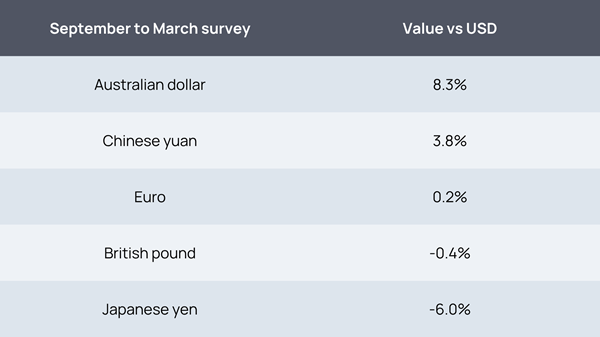
The start of 2026 also saw some significant currency changes. Bulgaria adopted the euro and Syria redenominated the pound, removing two zeros as part of a plan for monetary reform and to strengthen financial stability. By mid-January, the political and economic unrest seen in Libya saw a 15% devaluation of the dinar.
Inflation trends and forecast index changes
Alongside exchange rates, relative inflation also feeds into the index calculation. Taken together, these factors give an early indication of the locations likely to see the biggest index movements this survey.
In markets where currencies have remained broadly stable, inflation will be the primary driver of change. However, where exchange rate movements are more extreme, they tend to outweigh inflation.
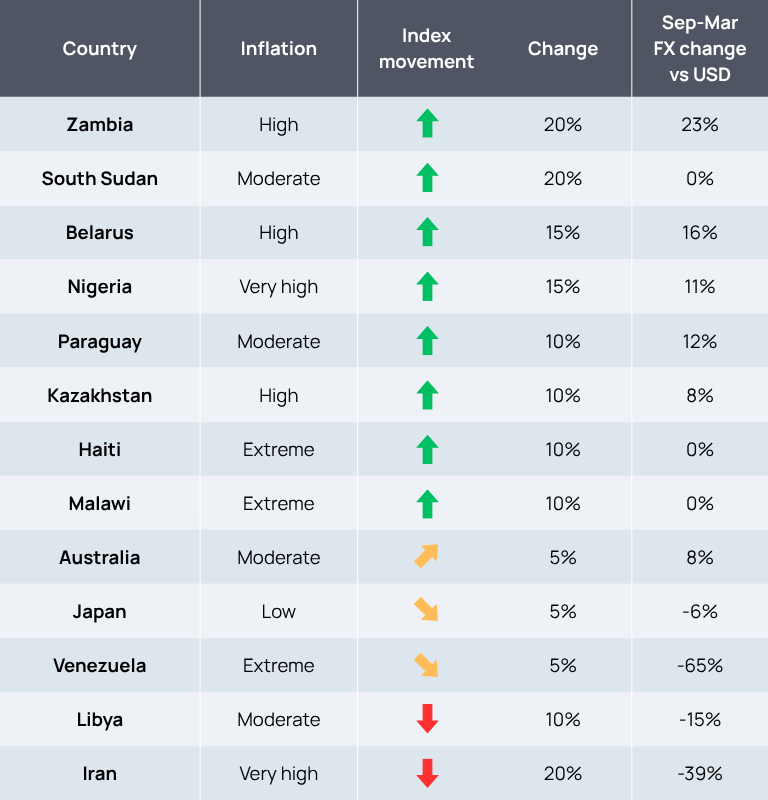
Estimated index movements from the USA between ECA’s September and March Cost of Living Surveys
Where indices are likely to rise
Several currencies appreciated more than 10% against the US dollar between surveys. Paired with moderate to high inflation, the significant currency appreciations in Belarus, Nigeria, Paraguay and Zambia will see indices to these countries rise significantly.
With exchange rates relatively stable, Malawi is likely to see upward index movement driven by sustained price increases.
Where indices are likely to fall
Instability remains prevalent in Venezuela, with the bolivar showing the largest depreciation of any currency between surveys, falling 65% against the US dollar. Despite the country’s extreme local-currency inflation, widespread dollarisation means assignees holding US dollars are not fully exposed to these price increases, and indices may fall as the bolivar’s depreciation outweighs inflation.
Similarly, the devaluation of the Libyan dinar will likely outweigh inflation, lowering indices to Libya.
Volatility and uncertainty
Some locations are difficult to predict due to ongoing instability.
In Iran, the rial has depreciated significantly between surveys, continuing a broader trend of currency weakness. Our December survey indicated a downward index trend, with the exchange rate movements outweighing inflation. However, the ongoing conflict will create supply disruption and additional inflationary pressure, making the March index results more difficult to predict.
Recent survey results for South Sudan suggest inflationary pressures may be easing, although price movements remain highly volatile, making the extent of any index change less certain.
Monitoring what comes next
Predicted index movements should be treated with caution. Exchange rates provide an early indication of likely index direction, but final results will also depend on how local prices have changed in the survey period. The Iran war may have a significant bearing on the March 2026 survey data, with its impact already visible in higher fuel costs. ECA will continue to monitor developments closely as analysis progresses ahead of publication in May.
ECA publishes cost of living data for more than 500 locations around the world. Learn more about our cost of living data by downloading our FREE Cost of Living white paper which explains how ECA's indices are calculated and applied to protect the buying power of people moving between countries as well as looking at what causes them to change over time.
Our cost of living data is available as part of a subscription or as one-off calculations. It is also built into ECA’s Build-up, Net-to-Net and Cost Estimate Calculators which enable calculations in seconds. Get in touch today!